
Fence length is only one input. A useful estimate also identifies the coated height, the faces receiving stain, openings that will remain uncoated, and the coverage printed for the selected product and surface.
Follow this guide to prepare the area before entering it in the fence stain calculator. The worked rates are labeled assumptions for arithmetic, not coverage promises or recommendations for a particular stain, wood, or application method.
Count each face you intend to stain
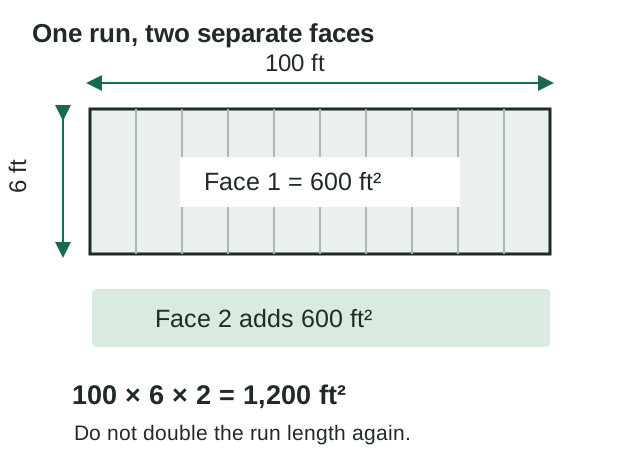
For a uniform solid run, multiply run length by coated height and by the number of faces that will receive stain. A 100-foot run at 6 feet high has 600 square feet on one face, or 1,200 square feet on two. Measure runs with different heights separately and add their areas.
This mode counts the selected broad faces; it does not infer posts, caps, rails, or board edges. Measure those surfaces separately if they matter. Enter their summed coated area in Measured wood area rather than hiding measured surface inside an unexplained allowance.
- List each run, gate face, rail, post, and other surface that will receive stain.
- Measure solid-run length and coated height in feet.
- Choose one face or both faces in solid-run mode.
- Identify openings that remain uncoated; calculate their deduction across the selected faces.
Handle gates, gaps and exposed board edges explicitly
Deduct only an opening that will remain uncoated. For a 4-by-6-foot gateway in a run where both fence faces are selected, the opening occupies 4 × 6 × 2 = 48 square feet across those faces. Subtract 48 from the 1,200-square-foot gross area to get 1,152 square feet. If a wood gate fills that opening and both gate faces will be stained, measure and add the gate instead of deducting it.
Open picket, shadowbox, and board-on-board fences are not solid rectangles of exposed wood. Add the broad faces and any rails, posts, or edges you intend to coat. Enter that total in Measured wood area; this mode does not apply a second face multiplier.
| Fence condition | Use this method | Avoid this mistake |
|---|---|---|
| Uniform solid privacy run | Length × height × selected faces | Doubling length and also selecting both faces. |
| Several runs of different heights | Calculate each run, then sum measured area | Using the tallest height everywhere. |
| Open pickets or shadowbox | Sum actual coated board and rail surfaces | Applying a universal fence-style multiplier. |
| Uncoated gateway | Deduct its area across selected faces | Deducting a wooden gate that will also be stained. |
Read the coverage basis before multiplying coats
Enter square feet per US gallon per coat. Confirm that the label’s coverage applies to the wood condition and application being planned. If documentation gives a total-system yield rather than a per-coat rate, resolve that basis before entering a coat count; otherwise the same coats can be counted twice.
This calculator applies one coverage value to every entered coat. If the first coat and later coats have different documented rates, calculate them separately and add the quantities. Do not force different rates into one field.
Lower coverage means more gallons. For the same 1,200-square-foot area and one coat, hypothetical rates of 150, 200, and 250 ft²/US gal produce 8, 6, and 4.8 US gallons. If the product gives a range for the applicable surface, calculate both endpoints instead of treating a midpoint as exact.
| Entered coverage | Calculation | Estimated stain |
|---|---|---|
| 150 ft²/US gal per coat | 1,200 ÷ 150 | 8 US gal |
| 200 ft²/US gal per coat | 1,200 ÷ 200 | 6 US gal |
| 250 ft²/US gal per coat | 1,200 ÷ 250 | 4.8 US gal |
Turn the net area into gallons and whole containers
Once area, coverage, and coat count are established, enter an allowance only if you choose one. The percentage is a planning input; it is not a researched absorption factor. Keep actual detail surfaces in the measured area.
At 1,200 ft², 200 ft²/US gal per coat, and one coat, the estimate is 6 US gallons. If the available container size is 5 US gallons, 6 ÷ 5 = 1.2, so the whole-container count rounds up to 2. You would purchase 10 gallons in that package size, while the material estimate remains 6 gallons. The calculator does not combine different container sizes to optimize a purchase.
Net area = length × height × faces − total deductions. Gallons = net area ÷ coverage per coat × coats × (1 + allowance ÷ 100). Containers = gallons ÷ container size, rounded up.
Keep surface readiness separate from quantity
A quantity estimate cannot determine whether the wood is ready for stain. Check the selected product’s surface-preparation, existing-finish, moisture, and weather instructions. This calculator supplies no universal moisture threshold or drying time.
Before purchase, verify the run faces, gate surfaces, measured rails and posts, and opening deductions. Confirm that coverage is entered per coat. Correcting those inputs is more useful than applying an unexplained percentage to an uncertain area.
Independently worked examples
These assumed inputs illustrate the arithmetic. Use your measurements and the current instructions for your selected product.
Both faces of a solid run
- 100 ft long, 6 ft high, both faces; no openings or extra allowance.
- Assumed coverage 200 ft²/US gal per coat, one coat, 5-gallon containers.
- 100 × 6 × 2 = 1,200 ft².
- 1,200 ÷ 200 = 6 US gal.
- 6 ÷ 5 = 1.2; round up to 2 containers.
- Exposed wood area
- 1,200 ft²
- Stain estimate
- 6 US gal
- Whole containers
- 2 containers
Deducting an uncoated gateway
- Same run with a 4 × 6 ft opening deducted across both faces.
- A 5-US-gallon package size is entered.
- 4 × 6 × 2 = 48 ft² deducted.
- 1,200 − 48 = 1,152 ft² net area.
- 1,152 ÷ 200 = 5.76 US gal; 5.76 ÷ 5 = 1.152, rounded up to 2 containers.
- Exposed wood area
- 1,152 ft²
- Stain estimate
- 5.76 US gal
- Whole containers
- 2 containers
Measured area with two instructed coats
- Measured coated wood totals 600 ft²; coverage is assumed to be 200 ft²/US gal per coat.
- No package size is entered.
- 600 ÷ 200 × 2 = 6 US gal.
- Measured-area mode uses the entered total directly; no face multiplier is applied.
- Exposed wood area
- 600 ft²
- Stain estimate
- 6 US gal
Buy from a documented area and coverage estimate
A checkable estimate records the coated surfaces, any uncoated openings, the product’s per-coat coverage, and the coat count. The calculator formats non-integer quantities to four significant digits; its whole-container count is rounded up to the next complete package. Keep the estimated use separate from the purchase total.
- Count each selected face once.
- Measure open or detailed fence surfaces rather than applying an invented factor.
- Use the exact product coverage and separate coats if their rates differ.
- Treat container rounding as a purchase decision, not additional calculated use.