
An epoxy mix ratio specifies the relative amounts of Part A and Part B. A ratio of 2:1 means two parts A for each one part B, measured using the basis stated by the product maker. It does not mean that Part B is half of the final mixture.
Before calculating, identify both the measurement basis—volume or weight—and the amount already known—total batch or Part A. The examples below use hypothetical ratios to demonstrate the arithmetic. Only the current instructions for your exact resin and hardener establish the ratio you should enter.
Match the ratio to the measuring method
A volume ratio must be measured by volume. A weight ratio must be measured by mass. US fluid ounces are volume; grams are mass. A scale reading in ounces is not a US fluid-ounce measurement from a graduated container.
Use the ratio documented for the method you will actually use. Resin and hardener may have different densities, so the numerical ratio by volume cannot automatically be used by weight. The calculator performs the split you enter; it does not convert between bases or verify the product ratio.
| Documented basis | Calculator basis | Measurement to enter |
|---|---|---|
| By volume | US fluid ounces by volume | Both components measured in US fl oz. |
| By weight | Grams by weight | Both components measured in grams. |
| Ratio has no stated basis | Resolve the product instructions first | Do not guess from the ratio numbers. |
| Only volume ratio supplied, but using a scale | Obtain the documented weight ratio | Do not reuse the volume numbers as weights. |
Split a known total into all of its parts
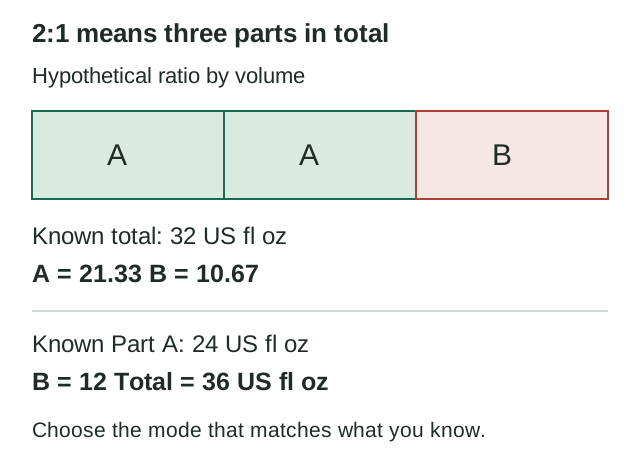
For a total batch T at A:B = a:b, add the parts first. A 2:1 ratio contains three total parts, so Part A is two thirds of the batch and Part B is one third.
At a hypothetical total of 32 US fl oz and 2:1 by volume, each part is 32 ÷ 3 = 10.6667 US fl oz. Part A is 2 × 10.6667 = 21.3333 US fl oz; Part B is 10.6667 US fl oz. The calculator displays these as 21.33 and 10.67, totaling 32. Keep enough precision for measuring. Display rounding does not define the product’s measurement tolerance.
For a known total T: A = T × a ÷ (a + b); B = T × b ÷ (a + b).
Use a different calculation when Part A is already measured
Choose Part A only when the amount already measured is the first component on the correct basis. Calculate the missing component as B = A × b ÷ a. For a hypothetical 2:1 volume ratio and 24 US fl oz of Part A, Part B is 24 × 1 ÷ 2 = 12 US fl oz, making 36 US fl oz total.
Entering 24 as the total batch answers a different question: it returns 16 US fl oz A plus 8 US fl oz B. Confirm the Known amount selection before dispensing either component.
For known Part A: B = A × b ÷ a; total mixed amount = A + B.
| Known amount and basis | Part A | Part B | Final total |
|---|---|---|---|
| 32 US fl oz total, by volume | 21.33 US fl oz | 10.67 US fl oz | 32 US fl oz |
| 24 US fl oz Part A, by volume | 24 US fl oz | 12 US fl oz | 36 US fl oz |
| 300 g total, assuming a documented 2:1 weight ratio | 200 g | 100 g | 300 g |
Check the labels and quantities before combining components
The calculator treats the first entered part as A and the second as B. Confirm that this order matches the resin and hardener on the product instructions; reversing the values changes the mixture. Do not reuse a remembered ratio from another bottle or system.
Correct proportions are only one step. Follow the product’s requirements for mixing tools, scraping, transfer or double-mixing, work conditions, and maximum batch size. The calculator cannot verify mixing quality or predict pot life, cure time, or exotherm.
- Read the current instructions for the exact resin and hardener combination.
- Select the correct basis and enter the A:B numbers in the documented order.
- Select Total mixed batch or Part A only, then enter the amount in the displayed units.
- Check that Part A + Part B equals the intended final batch before combining them.
Avoid the two most common arithmetic shortcuts
Do not divide a total batch by two to find Part B in a 2:1 mix. There are three parts altogether. Part B is one of those three; Part A is the other two.
Do not add extra hardener to speed cure or compensate for uncertain measurement. Confirm the basis and quantity before combining parts. If a batch is already off ratio, use the exact manufacturer’s guidance; this guide does not provide a recovery method.
Independently worked examples
These assumed inputs illustrate the arithmetic. Use your measurements and the current instructions for your selected product.
Split a total by volume
- Hypothetical 2:1 ratio by volume; desired mixed total is 32 US fl oz.
- 32 × 2 ÷ 3 = 21.3333 US fl oz Part A.
- 32 × 1 ÷ 3 = 10.6667 US fl oz Part B.
- The calculator displays four significant digits: 21.33 + 10.67 = 32.00 US fl oz.
- Part A
- 21.33 US fl oz
- Part B
- 10.67 US fl oz
- Total mixed batch
- 32 US fl oz
Add hardener to a known Part A amount
- Hypothetical 2:1 ratio by volume; Part A is already 24 US fl oz.
- 24 × 1 ÷ 2 = 12 US fl oz Part B.
- Part A remains 24 US fl oz.
- 24 + 12 = 36 US fl oz total.
- Part A
- 24 US fl oz
- Part B
- 12 US fl oz
- Total mixed batch
- 36 US fl oz
Split a total by weight
- A hypothetical product explicitly specifies 2:1 by weight; target total is 300 g.
- 300 × 2 ÷ 3 = 200 g Part A.
- 300 × 1 ÷ 3 = 100 g Part B.
- Part A
- 200 g
- Part B
- 100 g
- Total mixed batch
- 300 g
Confirm the basis, then confirm the batch
The ratio calculation is useful only after the product basis, component order, and known amount are correct. The page displays non-integer results to four significant digits. It retains the internal values for its total; small display-rounding differences can appear when rounded components are added by hand. Follow the product’s separate mixing and application instructions.
- Never substitute a volume ratio for a weight ratio.
- A total-batch amount and a known Part A amount require different calculations.
- Check component order and the full-precision total; do not alter hardener to control cure.