
Start with the void that will hold resin, not the outside dimensions of a mold or the full footprint of a table. The calculator estimates the combined mixed volume of resin and hardener from inside dimensions or a measured cavity capacity.
This guide explains the calculator’s rectangular, round, and measured-volume modes, then shows how its optional allowance changes the estimate. Every example uses assumed dimensions for arithmetic only. It does not establish an acceptable pour depth, batch size, or cure schedule for a particular epoxy.
Measure the cavity, not the outside of the mold
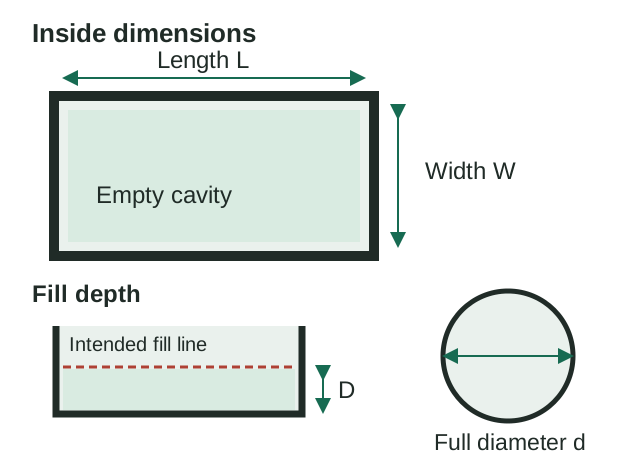
For a rectangular cavity, measure the inside length, inside width, and fill depth. Measure depth from the surface that will support the pour to the intended fill line. Subtract space occupied by wood or another object before entering the measurements; wall thickness and the mold’s outside dimensions do not describe the empty cavity.
For a circular cavity, measure its full inside diameter through the center. The calculator expects diameter, not radius. Because the radius is squared in the formula, entering a radius in the diameter field returns one quarter of the intended circular volume. Keep the units consistent across every dimension.
- Set Project shape to Rectangular pour, Round pour, or Measured mold volume.
- Set Measurement units before entering dimensions. The calculator converts dimensional inputs when you switch between inches and centimeters.
- Measure the inside cavity to the intended fill line; for an irregular channel, measure sections or establish its capacity independently.
- Enter fractions as decimals, such as 0.125 for 1/8 inch.
Choose the measurement method that fits the project
Use a rectangular approximation only when length, width, and fill depth represent the cavity reasonably well. For a tapered or irregular river channel, divide the void into smaller sections whose shapes can be measured, calculate each section, and add the volumes. One maximum-width measurement across the whole channel can overestimate the amount.
Choose Measured mold volume when the cavity capacity has already been established by a suitable volume-measurement method. Enter US fluid ounces in US mode or milliliters in metric mode. Weight ounces and grams are mass, not cavity volume; a mold or container’s weight does not reveal its capacity.
| Project geometry | Required measurement | Important check |
|---|---|---|
| Rectangular pour | Inside length × inside width × fill depth | Exclude occupied space; use consistent units. |
| Round pour | Full inside diameter and fill depth | Enter diameter, not radius. |
| Uneven channel | Separate measured sections, or established cavity capacity | Do not assume the entire tabletop is empty. |
| Measured capacity | US fl oz or mL of cavity volume | Do not substitute weight ounces or grams. |
Convert geometric volume into mixed epoxy
With inch inputs, length × width × depth gives cubic inches. Divide cubic inches by 231 for US gallons. With centimeter inputs, the geometry gives cubic centimeters, and one cubic centimeter equals one milliliter. The result panel reports the same mixed quantity as US gallons, US fluid ounces, and liters.
For a round mold, first calculate radius as diameter ÷ 2, then square it and multiply by π and depth. When checking the arithmetic, keep full precision through the conversion and round only the displayed results. This calculator formats non-integer outputs to four significant digits.
Rectangle: V = L × W × D. Circle: V = π × (d ÷ 2)² × D. Inch inputs: US gal = V ÷ 231; US fl oz = US gal × 128; L = US gal × 3.785411784.
| Cavity | Geometry and conversion | US gallons | US fluid ounces | Liters |
|---|---|---|---|---|
| 24 × 48 × 0.125 in rectangle | 144 in³ ÷ 231 | 0.6234 | 79.79 | 2.36 |
| 12 in diameter × 0.25 in round cavity | π × 6² × 0.25 = 28.2743 in³ | 0.1224 | 15.67 | 0.4633 |
| Measured capacity: 64 US fl oz | 64 ÷ 128 US fl oz per gallon | 0.5 | 64 | 1.893 |
Keep extra allowance separate from purchase and batch decisions
Extra allowance multiplies the base volume by 1 + allowance percentage ÷ 100. On the 144 in³ rectangle, a hypothetical 10% allowance gives (144 ÷ 231) × 1.10 = 0.685714… US gal, displayed as 0.6857 US gal. The percentage is an input assumption, not a universal factor for runoff, cups, wood absorption, or spills.
The result is total mixed material, not the amount of Part A from one container. Use the mix-ratio calculator with the manufacturer’s stated basis to split a batch. When purchasing, compare the estimate with the usable mixed yield stated for the kit; packaging volume and mixed yield are not always the same thing.
Check the product limits before planning a pour
A correct volume estimate does not establish a permitted pour depth, batch size, working time, or cure schedule. Check the current instructions for the selected resin system, including its depth, temperature, batch-mass, and staged-pour limits. These are product and process requirements, not outputs of the volume calculator.
If the project needs several pours, determine the permitted layer plan from the product documentation first. Estimate each planned cavity or layer for purchasing, but do not interpret the combined project volume as permission to mix that amount at once. Never change the stated hardener ratio to alter cure time or compensate for a temperature.
Independently worked examples
These assumed inputs illustrate the arithmetic. Use your measurements and the current instructions for your selected product.
Rectangular cavity without allowance
- Inside dimensions are 24 × 48 × 0.125 inches.
- No extra allowance; the depth is an arithmetic input, not a pour-depth recommendation.
- 24 × 48 × 0.125 = 144 in³.
- 144 ÷ 231 = 0.6233766 US gal before display rounding.
- 0.6233766 × 128 = 79.7922 US fl oz; 0.6233766 × 3.785411784 = 2.35974 L.
- Mixed epoxy
- 0.6234 US gal
- Mixed volume
- 79.79 US fl oz
- Metric volume
- 2.36 L
Round mold without allowance
- Full inside diameter is 12 inches; fill depth is 0.25 inches.
- Radius = 12 ÷ 2 = 6 in.
- π × 6² × 0.25 = 28.2743339 in³.
- 28.2743339 ÷ 231 = 0.1223997 US gal; multiply by 128 for US fl oz and 3.785411784 for liters.
- Mixed epoxy
- 0.1224 US gal
- Mixed volume
- 15.67 US fl oz
- Metric volume
- 0.4633 L
Measured cavity capacity
- Suitable measurement establishes empty capacity as 64 US fluid ounces.
- 64 ÷ 128 = 0.5 US gal.
- 0.5 × 3.785411784 = 1.892705892 L.
- Mixed epoxy
- 0.5 US gal
- Mixed volume
- 64 US fl oz
- Metric volume
- 1.893 L
Rectangle with a hypothetical 10% allowance
- Same rectangular cavity; the 10% value is an example input, not a recommended allowance.
- Base volume = 144 ÷ 231 = 0.6233766 US gal.
- Allowance multiplier = 1 + 10 ÷ 100 = 1.10.
- 0.6233766 × 1.10 = 0.6857143 US gal; convert that adjusted quantity to the displayed US fl oz and liters.
- Mixed epoxy
- 0.6857 US gal
- Mixed volume
- 87.77 US fl oz
- Metric volume
- 2.596 L
Finish with a volume estimate and a separate pour plan
A usable estimate states which cavity was measured, which unit system was used, and whether an allowance was entered. The calculator displays non-integer results to four significant digits; conversions are based on the unrounded internal value. Use that precision for planning, then measure components according to the exact product ratio and its instructions.
- Use inside dimensions or independently established capacity.
- Keep total mixed volume separate from the Part A/Part B split.
- Treat depth, batch size, and staging as product requirements, not calculator outputs.