
9 entries
Brushes
Synthetic or natural bristles
Typical use / tradeoff
Synthetic filaments appear in brushes for water- and oil-based coatings. Natural bristles are commonly specified for oil- and solvent-based finishes.
Read the particular brush’s coating compatibility, rather than treating every synthetic blend as identical.
Check against the coating
Match the applicator to the coating’s instructions; natural bristles are not a default choice for water-based paint.
Brushes
Soft or stiff filaments
Typical use / tradeoff
Softer filaments favor a smooth appearance; stiffer filaments help with cutting in and heavier coatings.
Filament material and stiffness describe different properties. Consider both when comparing brushes for trim or furniture.
Check against the coating
Try the selected brush with the actual coating on a sample. A stiffness label alone does not predict the finished surface.
Brushes
Angled or flat brush
Typical use / tradeoff
Angled ends help reach corners and cut an edge. Flat brushes suit longer strokes over continuous surfaces.
Choose the shape around the task: a trim edge differs from a broad fence board.
Check against the coating
Use a width that fits the work. A wider brush offers little advantage if it prevents controlled placement.
Brushes
Brush width and handle reach
Typical use / tradeoff
Wider brushes can cover broad surfaces; short handles help in confined areas.
Cabinet interiors, corners and trim can restrict handle movement even when the bristles fit.
Check against the coating
Check clearance and grip before loading the brush. Keep surface access separate from paint capacity.
Roller nap
1/4 or 3/8 in nap
Typical use / tradeoff
Short-nap examples commonly appear in guides for smoother surfaces.
A 1/4 in cover is a smooth-surface example; 3/8 in is a common wall-and-ceiling example. These sizes are not interchangeable product approvals.
Check against the coating
Compare the coating’s required cover and test the stipple on the prepared surface.
Roller nap
1/2 or 3/4 in nap
Typical use / tradeoff
Longer fibers can reach more surface texture.
Guide examples pair 1/2 in with light texture and 3/4 in with more textured ceilings or masonry.
Check against the coating
Texture and coating both matter. More paint pickup does not justify exceeding the specified application thickness.
Roller nap
1 in nap
Typical use / tradeoff
A longer-nap example for rough surfaces such as block or rough wood.
Greater reach and paint capacity come with a different surface pattern.
Check against the coating
Confirm the finish accepts that pattern. Do not select by nap alone.
Estimate exterior paint separatelyRoller construction
Woven or knitted cover
Typical use / tradeoff
Woven covers emphasize smooth appearance and low lint. Knitted covers emphasize paint pickup and release.
Fabric construction, fiber material and nap are separate specifications. The word “microfiber” alone does not identify all three.
Check against the coating
Check the complete cover specification and coating compatibility, especially for a clear or glossy finish.
Roller construction
Mini roller or wider cover
Typical use / tradeoff
A shorter cover helps with restricted areas; a wider one covers open areas.
When switching to a mini roller, matching the main cover’s fabric and nap helps maintain the surface pattern.
Check against the coating
Verify fit with the frame and test the transition between applicators. A brush may still be needed for corners.
No entries match. Clear the filters or try a broader phrase.
Choose an applicator by matching the coating, surface texture, area, and finish you want to see. A brush filament or roller nap is a physical specification; neither one guarantees a smooth result on an unprepared surface.
The lookup above gathers manufacturer examples for brush material and shape, roller nap, fabric, and width. Treat each size as a starting point to compare with the exact coating directions and a test panel.
Choose brush material, stiffness, and shape separately
For a water-based coating, use a brush whose maker lists it as compatible; synthetic filaments are a common compatible class. Natural bristles are commonly specified for oil- or solvent-based finishes, but the exact brush label controls. Do not assume “synthetic” means every blend has the same stiffness or paint release.
Softer filaments can leave fewer visible brush marks on smooth or glossy work. Stiffer filaments can help with crisp edges or heavier coatings. An angled brush may improve control near trim and corners, while a flat brush suits longer strokes across a broad surface. Width and handle reach determine whether you can load and move the brush without losing control.
| Specification | What it changes | Check before use |
|---|---|---|
| Bristle/filament material | Coating compatibility and release characteristics. | Exact coating type and brush-maker compatibility. |
| Softness or stiffness | Surface marking, edge control, and ability to move thicker coatings. | Smooth sample panel and intended cut-in detail. |
| Angled or flat shape | Access to corners versus long strokes on broad surfaces. | Edge geometry and the available working space. |
| Width and handle | Coverage per stroke and reach into confined areas. | Tool clearance, grip, and project scale. |
Match roller nap and fabric to texture and coating
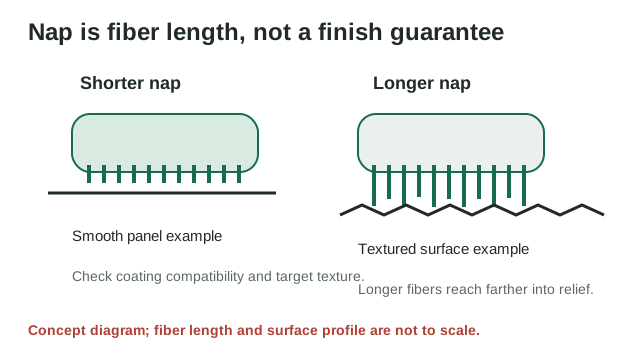
Nap is the length of the roller-cover fibers. A short nap picks up less material and is commonly paired with smooth surfaces; a longer nap can reach texture and carry more coating. Purdy’s examples include 1/4 inch for uniform interior surfaces, 3/8 inch for walls and ceilings, 1/2 inch for light texture, 3/4 inch for textured ceilings or masonry, and 1 inch for rough surfaces. These examples are not a universal schedule.
Fabric construction also matters. Woven covers are commonly used when a smoother result and low lint matter. Knitted covers can pick up and release more coating. Check nap, fabric, coating compatibility, width, and frame together. A narrow cover can reach a small panel or corner; it may leave a different pattern from the main roller, so compare on a sample.
Test the combination before covering the project
Use an offcut or inconspicuous area prepared like the project. Apply the same coating with the selected brush or roller, at the intended film build and under the intended conditions. Inspect coverage, stipple, lint, brush marks, and transitions between tools after the manufacturer’s stated drying or cure stage.
If changing one specification at a time, you can tell whether nap, fabric, or brush stiffness changed the appearance. Keep the test area and product notes together; do not treat a successful test on one substrate as approval for another coating or surface.
- Write down coating and substrate.
- Record the brush material/shape or roller material/nap/width.
- Apply a representative test with the intended method.
- Compare the dry result and consult the product instructions before proceeding.
Worked example
A smooth interior door with a water-based glossy enamel
Assumptions
- The coating label permits brush application.
- The door is smooth and fully prepared; this example is a selection process, not a brand recommendation.
Inputs or observations
- Task: brush a door face and cut in around panel details.
- Coating: water-based glossy enamel, as identified on its label.
- Surface: smooth wood with narrow recesses and trim edges.
Calculation or decision path
- Check the brush maker’s compatibility statement for water-based coating.
- Compare a softer filament for the smooth glossy face with an angled profile for controlled panel edges.
- Apply both on a prepared sample; use the tool that achieves the required coverage and appearance within the product instructions.
Result: The label and sample, not the words “soft” or “angled” by themselves, determine the usable brush. If using a roller on the broad face, select a compatible cover and verify its surface pattern on the same sample.
Common questions
- Does roller nap determine the exact finish?
- No. Nap, fabric, coating, surface texture, loading, and application technique all affect the result.
- Can one applicator specification be recommended for every coating?
- No. Match the exact coating directions and test the complete brush or roller combination.
Record the whole applicator, not one number
A useful tool note includes brush material, stiffness, shape, and width, or roller fabric, nap, width, and frame. Pair those specifications with the coating and substrate. If the sample differs from the target, resolve preparation and application before changing tools.
- Nap is not the only roller specification.
- Brush shape and filament stiffness serve separate tasks.
- Use product directions and a representative test to confirm the combination.