
7 entries
Low sheen
Flat
Appearance / common task
A low-reflection choice often used on ceilings and surfaces where imperfections need less emphasis.
Frequent wiping may affect appearance. Check the particular paint’s cleaning instructions.
What the name does not tell you
“Flat” does not establish scrub resistance or make the product suitable for every ceiling.
Low sheen
Matte
Appearance / common task
Little visible shine, with performance that depends on the formulation.
Some matte paints are made for washable walls or humid rooms. Do not reject or approve them from sheen alone.
What the name does not tell you
Read the intended-use statement and cleaning guidance for the exact product.
Intermediate sheen
Eggshell
Appearance / common task
A soft reflection commonly considered for living-area walls.
Compare a sample under the room’s lighting before committing to the whole surface.
What the name does not tell you
Eggshell and satin are not guaranteed equivalents across brands.
Estimate wall and ceiling quantitiesIntermediate sheen
Satin
Appearance / common task
A more noticeable luster, often considered for busy walls, doors or trim.
Its position relative to eggshell or pearl depends on the paint range.
What the name does not tell you
Confirm suitability for the substrate and use; a sheen name is not a cabinet-coating specification.
Intermediate sheen
Pearl, low lustre and velvet
Appearance / common task
Additional names used by manufacturers within their own sheen ranges.
Look at the product line’s chart rather than assigning these labels a universal rank.
What the name does not tell you
Compare actual samples. This row groups a naming issue; it does not claim identical finishes.
Higher sheen
Semi-gloss
Appearance / common task
A visible shine commonly used to define trim, doors and millwork.
Reflections can reveal preparation and application marks.
What the name does not tell you
Check cure and cleaning instructions before washing a newly painted surface.
Higher sheen
Gloss and high gloss
Appearance / common task
Strong reflection for an intentionally prominent finish on details such as doors or cabinets.
Surface smoothness and application technique become conspicuous.
What the name does not tell you
Do not assume two gloss labels represent the same measured gloss or that gloss alone proves durability.
No entries match. Clear the filters or try a broader phrase.
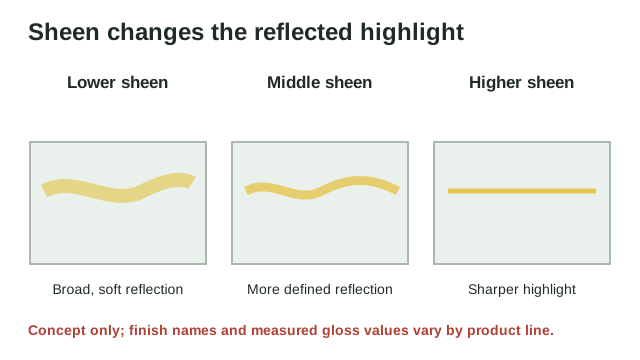
Sheen describes how a painted surface reflects light. It changes the way color and surface texture appear, but it does not identify a coating’s complete performance or intended use.
Manufacturers use overlapping names such as matte, eggshell, satin, pearl, low-lustre, and semi-gloss. Read sheen names within the exact product line; do not assume two brands’ labels correspond to the same measured gloss or wash performance.
Read sheen as a within-line comparison
Within a single product family, finishes are generally arranged from less reflective to more reflective. Product lines may add intermediate names or use different labels for a similar position. A name such as “pearl” or “velvet” is not a standard numerical conversion.
Compare the manufacturer’s complete sheen chart for the exact paint line. When a numerical gloss value is specified, keep its measurement angle and test method with the value. Sheen names do not define a universal numerical gloss conversion.
| Label family | Appearance question | Product-specific check |
|---|---|---|
| Flat / matte | How much light is reflected, and how visible are surface marks? | Cleaning, burnishing, moisture suitability, and substrate. |
| Eggshell / low-lustre | How does the low-to-mid sheen look in the room? | The product line’s position and cleaning guidance. |
| Satin / pearl | Is a more visible reflection appropriate for this surface? | Named finish in the product line; do not infer equivalence. |
| Semi-gloss / gloss | Will reflections emphasize surface preparation and application marks? | Intended substrate, application directions, and care instructions. |
Select for the room, substrate, and maintenance
Start with the surface and what it must withstand: moisture exposure, cleaning frequency, traffic, and product-specific restrictions. Then compare the available sheens in the coating family approved for that substrate. A room label alone—“bathroom,” “kitchen,” or “hall”—cannot select a paint.
Low-sheen finishes can make surface irregularities less prominent, while stronger reflections can highlight them. Durability and washability depend on the formulation, not sheen alone. A manufacturer’s special-purpose matte product may be designed for a high-humidity room; that does not make another matte wall paint suitable for the same use.
Compare color and reflection on a real sample
Paint a prepared sample with the exact color and finish being considered. View it in the intended room under daytime and installed lighting, from normal viewing positions. A color card can identify the color; a coated sample also shows the surface reflection and application texture.
Allow the sample to reach the product’s stated evaluation stage before comparing it. If a surface defect is visible, decide whether preparation or application needs correction. Do not hide a coating or substrate problem by automatically selecting a higher or lower sheen.
Worked example
A homeowner wants a matte finish in a humid bathroom
Assumptions
- The owner prefers a low-reflection appearance.
- The room experiences high humidity; the paint still must be suitable for the substrate and exposure.
Inputs or observations
- Desired appearance: matte.
- Location: bathroom with frequent humidity.
- Product candidates: exact paint-line label and technical data, not sheen name alone.
Calculation or decision path
- Check whether each candidate explicitly lists bathroom or high-humidity use.
- Compare required preparation, ventilation, recoat, and service directions.
- View a sample of the selected color and sheen under the room’s lighting.
Result: A named bathroom-formulated matte product can be considered when its own directions cover the intended surface and conditions. The result does not generalize that approval to all matte paints.
Common questions
- Does a higher sheen guarantee a more washable paint?
- No. Cleaning and durability depend on the product formulation and its stated use, not the sheen label alone.
- Is satin always glossier than eggshell?
- Do not assume exact cross-brand positions. Compare the finish chart within the specific product line.
Choose a named product finish, then inspect a sample
Use sheen names to narrow a comparison within a product line. Use current product information to confirm intended use and performance, and use a sample to judge reflection and color in place.
- Sheen labels are not universal gloss-unit values.
- Do not infer cleanability from sheen alone.
- Compare samples under the actual room lighting.