
14 entries
Mixing
Mix ratio
Meaning in practice
The specified relative amounts of components in a multi-part material.
A:B describes component proportions, not the fraction of B in the final batch. Keep component order and the stated measurement basis with the numbers.
Mixing
By weight / by volume
Meaning in practice
Two different ways to measure components.
A scale measures mass; a graduated container measures volume. Matching ratio numbers do not make the two methods interchangeable.
What to check
Use the manufacturer’s ratio for the method you actually use.
Understand epoxy mix ratiosTime
Pot life
Meaning in practice
The usable time after mixing under specified test conditions.
A quoted pot-life value belongs to a stated material and test setup. It is not a universal timer for every batch size.
What to check
Record test temperature, sample quantity and the maker’s definition.
Time
Working time
Meaning in practice
The usable application period described by the product maker.
Check how the maker distinguishes this term from pot life; do not assume two time labels share a test.
What to check
Look for the conditions attached to the value, not only the number of minutes.
Time
Demold time
Meaning in practice
The stated point at which a casting can be removed without unacceptable distortion.
Removal from a mold is a handling stage. It need not be the end of property development.
What to check
Read any later cure or post-cure requirements before putting the part into service.
Time
Touch dry, recoat and cure
Meaning in practice
Different milestones in a coating’s progress toward use.
A surface that can be touched may not be ready for another coat. A recoatable film may still need more time before ordinary use.
What to check
Find the applicable milestone and conditions in the product instructions; this glossary supplies no wait time.
Material properties
Viscosity
Meaning in practice
Resistance to flow in the material state being measured.
A mixed-liquid viscosity says something different from cured hardness.
What to check
Note whether the value describes a component or mixture, its temperature and the test method.
Material properties
Shore hardness
Meaning in practice
A hardness reading reported on a named durometer scale.
Keep the scale letter with the number. A Shore A value and a Shore D value are not a shared numeric scale.
What to check
Check scale, test age and the stated cure conditions; hardness alone does not establish suitability.
Material properties
Density
Meaning in practice
Mass per unit volume for the specified material state.
Density links a volume estimate to a mass estimate. Use mixed density when estimating mixed mold material.
What to check
Check units and whether the figure applies to Part A, Part B or the mixture.
Pour-on mold material calculatorFilm and coverage
Wet film thickness (WFT)
Meaning in practice
The thickness of the applied coating while it is still wet.
WFT is an application measurement, rather than the thickness remaining after drying.
What to check
Use the coating’s volume-solids basis when relating WFT to DFT.
Wet film thickness calculatorFilm and coverage
Dry film thickness (DFT)
Meaning in practice
The thickness of the coating after its specified drying or curing stage.
DFT and WFT describe different states of the film; a target DFT is not a wet-film reading.
What to check
Get the target and measurement conditions from the coating instructions.
Film and coverage
Solids by volume
Meaning in practice
The volume fraction expected to remain as coating film after volatiles leave.
Solids by weight is a different property and cannot replace this input in a film-thickness relationship.
What to check
Read the value for the product as supplied and account for any permitted reduction.
Film and coverage
Theoretical coverage
Meaning in practice
Calculated area at a stated film thickness before application losses.
This is a geometry-and-solids result, not a guaranteed spread rate on a real substrate.
What to check
Keep surface profile, transfer losses and material left in equipment separate.
Theoretical coverage calculatorDocuments
TDS and SDS
Meaning in practice
Technical Data Sheet and Safety Data Sheet serve different reading tasks.
Use the TDS to locate application properties and conditions. Use the SDS for the product’s hazard and handling information.
What to check
Match both documents to the exact product and current revision. Neither is a universal recipe for another material.
No entries match. Clear the filters or try a broader phrase.
A technical data sheet is useful only when its values are read with the component, unit, test method, and material state attached. “30” can describe a mix ratio, a Shore hardness, or a time in minutes; those values do not mean the same thing.
Use the searchable glossary above to locate a term, then follow the label or data sheet for the exact product. The example shows how a definition affects a calculator input without turning a general term into a product recommendation.
Keep a ratio’s parts and measurement basis together
An A:B ratio states relative parts in a specified order. The basis may be volume or weight. US fluid ounces measure volume; grams measure mass. Equal ratio numbers on the two bases are not interchangeable unless the manufacturer explicitly supplies both.
For a total batch, divide the total by the sum of the parts, then allocate each component. For a known Part A amount, calculate Part B from the ratio directly. Check the calculator’s mode and units before measuring.
For A:B = a:b and total T: A = T × a ÷ (a + b); B = T × b ÷ (a + b). For known A: B = A × b ÷ a.
| Label detail | What it identifies | Common misreading |
|---|---|---|
| A:B order | Which component each number belongs to. | Reversing the components. |
| By volume | Relative measured liquid volumes. | Using the same numbers on a scale. |
| By weight | Relative component masses. | Treating ounces by weight as US fluid ounces. |
| Total batch / Part A | Which quantity is already known. | Splitting a known Part A as if it were the full batch. |
Separate working time from later milestones
Pot life, working time, demold time, recoat time, and full cure describe different stages. A maker may define pot life under a particular sample size and temperature. Demold time describes a handling point; it does not automatically mean the material has reached every final property.
When two documents use a time term differently, preserve the manufacturer’s wording and test conditions. Do not combine the shortest number from one source with the process conditions from another.
Distinguish liquid, coating-film, and cured-material properties
Viscosity describes flow of a liquid under stated test conditions. Density relates mass to volume for a specified material state. Shore hardness is measured on a named scale after a stated cure and conditioning period. A Shore A reading is not directly interchangeable with a Shore D reading.
For coatings, wet-film thickness (WFT) describes the applied wet layer. Dry-film thickness (DFT) describes the remaining film after volatile material leaves. Volume solids describes a volume fraction; solids by weight is a different property. Do not substitute one for the other in a film calculation.
| Property | State or basis to record | What it does not establish alone |
|---|---|---|
| Viscosity | Material or mix, unit, temperature, and test method. | Pour suitability or bubble release. |
| Density | Part A, Part B, or mixed system; mass and volume units. | The volume capacity of a container. |
| Shore hardness | Scale letter, specimen age, cure, and test condition. | Compatibility, strength, or intended use. |
| WFT / DFT | Wet or dry state, unit, solids value, and target source. | Actual applied thickness without measurement. |
Worked example
Split a hypothetical 12-fluid-ounce batch at 2:1 by volume
Assumptions
- The example assumes the selected product explicitly specifies A:B = 2:1 by volume.
- The target is total mixed volume, not Part A alone.
Inputs or observations
- Mode: total batch.
- Total amount: 12 US fl oz.
- Ratio basis and order: Part A to Part B, by volume, 2:1.
Calculation or decision path
- Total parts = 2 + 1 = 3.
- One part = 12 ÷ 3 = 4 US fl oz.
- Part A = 2 × 4 = 8 US fl oz; Part B = 1 × 4 = 4 US fl oz.
Result: The parts add to 12 US fl oz. These values are an arithmetic illustration, not a universal epoxy ratio.
Check the related calculatorCommon questions
- Are a volume ratio and a weight ratio interchangeable?
- No. Use only the exact basis specified for the product and component combination.
- Does demold time mean the material is fully cured?
- Not necessarily. Check the manufacturer’s definitions for demolding, cure, and any later conditioning.
Copy the conditions along with the number
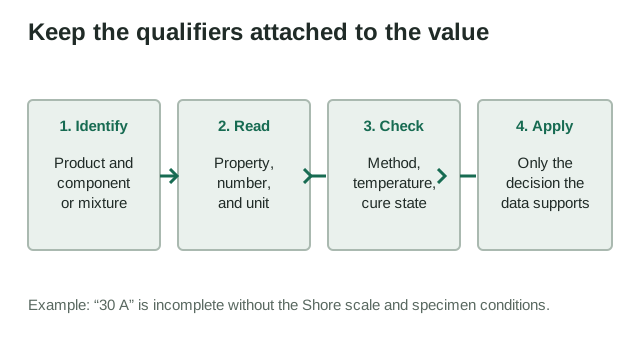
When using a value in an estimate, record the exact product, document revision, component or mixture, unit, measurement basis, test method, temperature, and cure age when applicable. If any of these are unknown, do not infer them from a nearby number.
- Read the full label around a ratio or property.
- Do not combine terms whose test conditions differ.
- Use product instructions for values that determine application.