
3 entries
Wood finish
Minwax Polycrylic: brush-applied finish
Stated time and basis
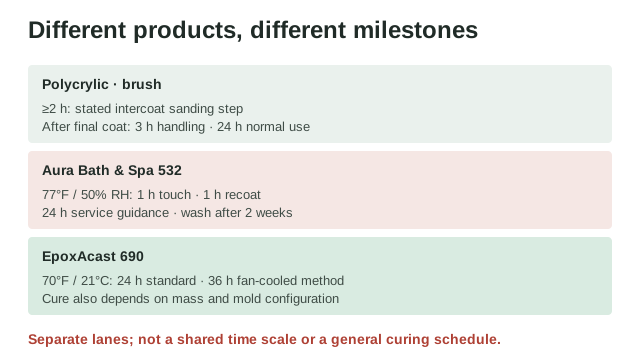
Between coats: at least 2 hours before the specified sanding step. After the final coat: 3 hours to light handling and 24 hours to normal use.
Keep these stages separate. This schedule describes brush application and does not establish a full-cure time.
Before the next operation
Match the package and application directions. These times are not tied to a single temperature/humidity pair here; check the conditions on your current container.
Wall paint
Benjamin Moore Aura Bath & Spa Matte 532
Stated time and basis
At 77°F / 25°C and 50% relative humidity: 1 hour to touch and 1 hour to recoat.
The TDS calls for at least 24 hours before full service for best results, and permits washing after 2 weeks.
Before the next operation
Cooler temperatures and higher humidity lengthen these stages. The washing interval is not labeled here as a universal full-cure time.
Casting epoxy
Smooth-On EpoxAcast 690: casting cure
Stated time and basis
The bulletin lists 24 hours for standard casting and 36 hours for its fan-cooled method at 70°F / 21°C.
Pot life is a separate value. The manufacturer says cure time depends on mass and mold configuration.
Before the next operation
Do not select a method from its time alone. Use its complete process and dimensional limits; this entry does not approve a pour or a recoat.
Read the selected material propertiesNo entries match. Clear the filters or try a broader phrase.
“Dry” is not one milestone. A coating may be dry to touch, ready to sand, ready for another coat, ready for light handling, or ready for normal service at different times. A casting material may report pot life and cure time under a specific mass and method.
The table above keeps a few named product intervals attached to their conditions and next operation. It is not a universal drying schedule or a timer that adjusts one product’s time for another.
Name the operation that must wait
Before using a time value, write the operation next to it: touch, sand, recoat, demold, handle, wash, or return to service. A “recoat” interval does not automatically set a full-cure date. A surface that can be touched may still be too soft for sanding or ordinary use.
The manufacturer’s instructions define what a time means and under what test or application conditions it was measured. Match the product, variant, application method, coat thickness, temperature, humidity, and substrate as closely as the documentation requires.
| Milestone wording | Question it answers | Do not assume |
|---|---|---|
| To touch | When may the surface resist a light touch as described? | That it is ready to sand, wash, or use. |
| To recoat | When may the next coat be applied under the stated system? | That the film has reached full service properties. |
| To sand between coats | When does the stated sanding step become appropriate? | That every product requires intercoat sanding. |
| To demold / cure | When does the named casting or mold reach the stated stage? | That all masses, methods, or cure conditions share one duration. |
| Light handling / normal use | When may the item be handled or returned to the stated use? | That separate cleaning or chemical-resistance milestones have passed. |
Carry the conditions with the time
Write down the exact product and package, whether it is brush- or spray-applied, the coat number, ambient and surface temperature, humidity if specified, and the time the coat was applied. If a source does not state a condition, do not fill it in from another product’s data.
If product pages and application directions disagree, preserve the discrepancy and check the current package label or ask the manufacturer. Do not average two different intervals or choose the shorter one to simplify a schedule.
Build the project sequence from the actual label
For a multi-coat finish, use the manufacturer’s recoat and preparation directions between coats, then use the separate handling or service interval after the last coat. Do not add unrelated times such as pot life to a post-application schedule.
For a casting resin, the maker may distinguish standard and alternative curing methods, and cure can depend on mass or mold configuration. Do not select a method from the shortest printed duration; verify the complete process limits for that exact casting system.
Worked example
Plan the next steps for a brush-applied Polycrylic sample
Assumptions
- The product information lists a 2-hour recoat time; its brush directions call for at least 2 hours before the specified between-coat sanding step.
- After the final coat, the product page states 3 hours before light handling and 24 hours before normal use.
- The current container’s directions govern the required application and drying conditions.
Inputs or observations
- Product: Minwax Polycrylic Protective Finish, brush application.
- Sequence: one coat, the stated intercoat preparation, then a second/final coat.
- Unknown: actual application time, site conditions, and whether the current container imposes longer waits.
Calculation or decision path
- After coat one, wait at least the stated two-hour period before the listed sanding/preparation step; follow the package instructions before applying coat two.
- Start the post-final-coat intervals from the actual final application, not from the first coat.
- Plan for the stated 3-hour light-handling and 24-hour normal-use milestones after the final coat; verify the current package and conditions.
Result: The reference gives product-specific milestones but does not calculate a guaranteed completion time. The current label and actual conditions control the project schedule.
Common questions
- Does recoat time mean fully cured?
- Not unless the product maker explicitly defines it that way. Recoat and return-to-service milestones are different operations.
- What should I do when two instructions conflict?
- Keep the conflict visible and verify the exact package with the manufacturer. Do not average the times or choose the shorter one.
Schedule by milestone, product, and condition
Use this page to distinguish the interval you are waiting for from the operation you plan next. Record the exact product, application method and conditions with each milestone.
- Do not call every milestone “full cure.”
- Do not transfer a time from one product or method to another.
- Confirm the next operation against the current package label.