
6 entries
Cure
Sticky or soft after the expected cure
Checks to make
Check component identity, ratio, mixing and recorded temperature.
Compare the actual measurement basis and elapsed time with the exact system’s instructions. Patches that differ from the rest of the batch are useful observations to record.
Decision boundary
Do not add hardener to the surface or cover uncured material. Ask the manufacturer about removal and recovery for this system.
Check the ratio basisSurface appearance
Bubbles or pinholes
Checks to make
Record whether defects begin during mixing, spreading or curing.
Separate air introduced during handling from air released by the substrate. Record substrate temperature trend and where defects occur.
Decision boundary
A clear-coating observation is not a casting remedy. Consult the material’s application procedure before changing heat, depth or technique.
Surface appearance
Cloudiness in a clear coating
Checks to make
Check where the haze sits and document conditions.
Photograph surface haze and haze within the material separately. Record humidity and handling details for technical support.
Decision boundary
Appearance alone does not establish the cause. Test only a maker-approved response on a small affected area.
Surface preparation
Waxy or greasy surface film
Checks to make
Some cured epoxy systems can develop amine blush.
Identify the system and compare the surface with its preparation instructions before the next coat.
Decision boundary
Do not assume all sticky surfaces are blush or that a generic solvent wipe is the right preparation.
Surface preparation
Fish-eyes or areas pulling apart
Checks to make
Investigate contamination and the prepared surface.
Keep notes on cleaners, mixing containers, wiping materials and contact with the surface.
Decision boundary
Confirm preparation with the maker before recoating. Adding material may leave the original problem underneath.
Recoat
A topcoat will not set over epoxy
Checks to make
Check epoxy cure and coating compatibility.
Record the underlying resin, topcoat, wait time and preparation sequence.
Decision boundary
A new coat is not a cure test. Obtain product-specific advice before continuing.
No entries match. Clear the filters or try a broader phrase.
A surface defect is an observation, not a diagnosis. Sticky resin, bubbles, cloudiness, fish-eyes, and poor topcoat cure can arise from different materials or process conditions. A repair chosen before identifying the product and conditions can make the project harder to assess.
Use this page to document what happened and decide what to verify next. It does not prescribe a cure, heat treatment, solvent, removal method, or structural repair for an unknown epoxy system.
Record the batch before changing the surface
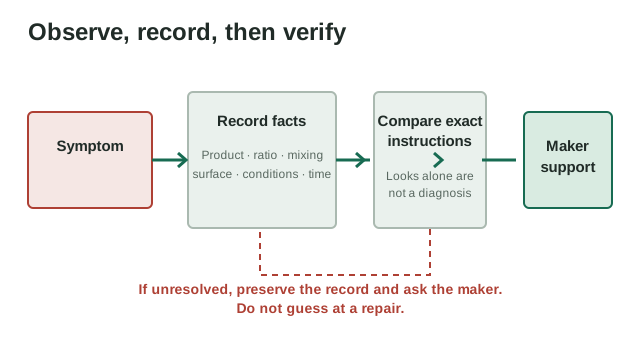
Write down the exact resin and hardener names, lot or package information, ratio basis, measured amounts, batch size, mixing sequence, substrate, application thickness, room and material temperatures, elapsed time, and photographs. Mark where a symptom appears: throughout the batch, only at the substrate, or in isolated patches.
These details help distinguish a batch-wide observation from an interface or localized surface issue. They do not prove the cause. Preserve the product label and current technical data sheet so a technical-support question can be answered against the correct system.
- Stop adding material or changing the surface while the facts are unclear.
- Photograph the whole work and a close view with a scale if useful.
- Record exact component amounts and whether each was measured by mass or volume.
- Compare elapsed time and conditions with that product’s own instructions.
- Ask the manufacturer about a remedy if the condition remains outside its stated process.
Compare the pattern without treating it as proof
A soft batch throughout and a tacky layer only at the master surface are different observations. Bubbles that appear during mixing may call for different questions than pinholes that appear later over porous wood. Haze within a clear cast is not the same as a surface film. Record location and timing before choosing a troubleshooting category.
Some epoxy systems can develop surface blush; a waxy appearance alone does not identify blush. Fish-eyes can indicate surface contamination, but an appearance match does not prove which cleaner, handling step, or substrate caused it.
| Observed pattern | Useful facts to record | What the pattern does not prove |
|---|---|---|
| Soft or sticky throughout | Parts, ratio basis, measured amounts, mixing, batch size, temperature, elapsed time. | That extra hardener or heat is an appropriate remedy. |
| Tacky only at an interface | Master/substrate identity, preparation, contact materials, cure conditions. | That the entire batch ratio was wrong. |
| Bubbles or pinholes | When defects appear, where they cluster, substrate, mixing and application notes. | That a casting and a thin coating need the same correction. |
| Haze, film, or fish-eyes | Surface versus internal location; cleaners, humidity, handling and coating sequence. | A specific contaminant or universally suitable solvent. |
| Topcoat remains unset | Underlying epoxy, topcoat, elapsed time, preparation and exact product pair. | That applying another coat will solve the problem. |
Use a product-specific decision path
First verify the written mixing ratio and measurement basis. Next check whether the recorded amount matches that ratio. Then compare mixing and environmental conditions with the product instructions. If the pattern still differs from the documented outcome, send the manufacturer the record rather than trying several unverified remedies in sequence.
A small compatibility test may be appropriate when the manufacturer recommends one, but a test result on one substrate or surface treatment does not establish suitability for every part of the project. This guide does not assess structural bonds or approve a repaired casting.
Worked example
The recorded ratio matches, but the interface is still tacky
Assumptions
- Hypothetical resin instructions state 2:1 by weight.
- The batch record shows 20 g Part A and 10 g Part B.
- Only the area in contact with the master is reported as tacky.
Inputs or observations
- Observed pattern: tacky interface; the rest is firmer.
- Recorded components: 20 g A, 10 g B, both weighed.
- Other facts to collect: mixing sequence, material and room temperatures, master material and preparation, elapsed time.
Calculation or decision path
- 20 g ÷ 10 g = 2, so the measured amounts match the stated 2:1 weight proportion.
- This arithmetic checks the recorded quantities only; it does not verify mixing quality, materials, temperature, or cure.
Result: Do not infer a cause from the ratio check. Preserve the sample and record, then follow the named system’s instructions or contact its technical-support channel about the tacky interface.
Check the related calculatorCommon questions
- Should I add extra hardener to a tacky batch?
- Do not treat extra hardener as a general cure remedy. Follow the exact product maker’s troubleshooting instructions.
- Does one symptom identify the cause?
- No. Record the pattern, timing, materials, amounts, and conditions before asking for a product-specific diagnosis.
Let the record guide the next question
Describe what is observable, gather the product and process facts, and compare them with the exact system documentation. Keep repair instructions product-specific. A symptom reference is useful when it helps ask a better question; it cannot replace the maker’s diagnosis for an unknown material.
- Do not add hardener to a cured or uncured surface as a generic fix.
- Separate bulk cure issues from interface and appearance issues.
- Do not treat an example or symptom list as a repair authorization.