
4 entries
Platinum silicone
Smooth-On Mold Star 30
Reported properties
Mixed viscosity: 12,500 cP. Cured hardness: Shore 30 A.
The bulletin names ASTM D2393 for viscosity and ASTM D2240 for hardness. The liquid and cured values describe different states.
Conditions and limits
The technical table carries a 7-day, 73°F / 23°C conditioning note. This pourable rubber is not specified for brush-on moldmaking.
Platinum silicone
Smooth-On Dragon Skin 10 Fast
Reported properties
Mixed viscosity: 23,000 cP. Cured hardness: Shore 10 A.
Keep “Fast” with the name; the series contains other working speeds. A shared hardness does not make those versions the same process.
Conditions and limits
The table carries a 7-day, 73°F / 23°C conditioning note. Hardness does not establish compatibility with a particular master.
Check silicone inhibition factorsTin silicone
Smooth-On OOMOO 30
Reported properties
Mixed viscosity: 4,250 cP. Cured hardness: Shore 30 A.
This is a tin-catalyzed silicone. Its 30 A hardness does not imply the same tear behavior or library life as another 30 A product.
Conditions and limits
The technical table carries a 7-day, 73°F / 23°C conditioning note. Compare the full property set for the intended mold.
Casting epoxy
Smooth-On EpoxAcast 690
Reported properties
Mixed viscosity: 280 cP. Cured hardness: Shore 80 D.
The bulletin reports physical properties after 7 days at 70°F / 21°C. The D scale is separate from the silicone A-scale entries.
Conditions and limits
Use the exact system’s casting instructions. Low viscosity and a hardness number do not establish a permitted pour depth.
Keep cure stages separateNo entries match. Clear the filters or try a broader phrase.
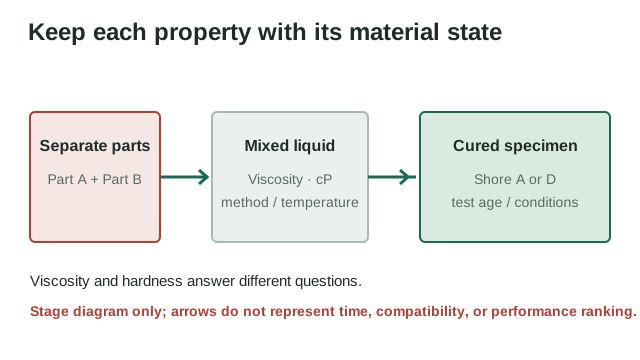
A specification comparison is meaningful only when the material name, property, unit, measurement method, and material state are all visible. Viscosity describes a liquid mixture; Shore hardness describes a cured specimen on a named scale. A similar hardness number does not make two mold rubbers interchangeable.
The lookup above intentionally covers four named products rather than acting as a complete market directory. Verify the latest technical bulletin and safety data for the exact variant and package before using any figure.
Compare like properties at like states
Mixed viscosity is reported in centipoise (cP); some manufacturer tables print “cps” for the same unit. Confirm whether the number applies to the mixed system, which test method is identified, and the stated conditions. Do not infer that a lower viscosity will prevent every bubble or permit a particular pour geometry.
Shore hardness must retain its scale letter. Shore A and Shore D are separate test scales, so do not place their numbers in one numeric ranking. Check the specimen conditioning and test method when comparing cured properties.
| Named material | Mixed viscosity | Cured hardness | Conditioning or scope note |
|---|---|---|---|
| Mold Star 30 | 12,500 cP | 30 A | Manufacturer bulletin; pour-on mold rubber, not intended for brush-on molds. |
| Dragon Skin 10 Fast | 23,000 cP | 10 A | Keep the “Fast” variant name; other series variants have different working times. |
| OOMOO 30 | 4,250 cP | 30 A | Tin-cure silicone; do not infer identical tear properties from a 30 A value. |
| EpoxAcast 690 | 280 cP | 80 D | Casting epoxy; the D scale is not directly comparable to silicone Shore A. |
Read the footnotes before using a value
A product data table can combine handling properties and cured physical properties. Read the footnote nearest the physical-property values to see the cure age and temperature used for those specimens. A viscosity number, pot life, and Shore reading are different measurements and may not share one test condition.
Check whether the bulletin gives a mixed ratio by weight or volume, target use, temperature limits, and working/cure times. Those fields are not all inputs to this reference page; they are part of deciding whether the product merits further review.
Use specifications to screen questions, not rank products
A value can help you prepare a product-specific question: “Is the stated mixed viscosity suitable for my measured cavity and method?” It cannot answer suitability without application geometry, equipment, working conditions, strength needs, compatible casting material, and maker instructions.
The four product rows are examples of reading manufacturer data. They are not a performance test, purchasing recommendation, substitution table, or safety assessment. If a value changes in a later bulletin, preserve the exact document revision with your project notes.
Worked example
Two listed silicones share a Shore number but not a viscosity value
Assumptions
- Both values are transcribed from their named Smooth-On technical bulletins.
- This ratio compares only the published viscosity figures; it is not a measure of mold quality.
Inputs or observations
- Mold Star 30: 12,500 cP mixed viscosity; 30 A cured hardness.
- OOMOO 30: 4,250 cP mixed viscosity; 30 A cured hardness.
Calculation or decision path
- 12,500 cP ÷ 4,250 cP = 2.941…; the listed Mold Star 30 viscosity number is about 2.94 times the listed OOMOO 30 number.
- Both report 30 A, but one is platinum-cure and the other tin-cure. Keep catalyst type and full product data with the values.
Result: The arithmetic illustrates why one property cannot stand in for the complete system. It does not predict pourability, cure compatibility, tear strength, or suitability for a specific master.
Common questions
- Can I rank products by Shore hardness?
- Not safely from one number. Keep the scale, test conditions, cure age, and material use with the value.
- Does lower viscosity prove easier or better pouring?
- No. Geometry, pot life, mixing, temperature, and the manufacturer’s permitted process also matter.
Use the bulletin, not a single comparison number
This table is a compact orientation to a few named technical values. Select a material only after comparing the current instructions for its complete product system and the project conditions.
- Keep cP with the mixed-liquid measurement.
- Keep the A or D letter with Shore hardness.
- Do not make a substitution based on one shared number.