
6 entries
Master materials
Sulfur-containing modeling clay
Why it needs checking
Some silicone instructions identify sulfur clay as an inhibition risk.
Mold Star specifically excludes curing against sulfur-containing surfaces even when sealed.
Product-specific next check
Identify the clay composition and the silicone’s restriction. A generic “seal it first” rule does not override that exclusion.
Handling and contamination
Latex contact
Why it needs checking
Latex is named as an inhibition source in the selected silicone instructions.
Include gloves, rubber parts and contact with the master in the process record.
Product-specific next check
Follow the exact silicone’s handling instructions and check all contact materials. Do not infer compatibility from the glove’s color or appearance.
Silicone systems
Tin-cure silicone near platinum silicone
Why it needs checking
Tin-cure silicone is listed as a potential inhibitor for addition-cure systems.
“Silicone against silicone” is not enough information to establish compatibility.
Product-specific next check
Identify both chemistries, the actual contact surface and any treatment. Confirm the intended pairing with the manufacturer.
Master materials
Newly cast resin or certain wood surfaces
Why it needs checking
The selected platinum-silicone instructions name fresh polyester, epoxy or urethane rubber, and certain wood surfaces.
A master’s material family alone does not describe its cure state or surface contamination.
Product-specific next check
Document the master’s product, age and preparation. Use a small compatibility test following the silicone maker’s instructions.
Master materials
SLA / UV-resin printed master
Why it needs checking
Incomplete curing and poorly exposed areas can matter when molding a resin print.
Published treatment results belong to named silicone and preparation combinations; they are not a guarantee for another print resin.
Product-specific next check
Use both the print-resin and mold-rubber instructions. This page supplies no universal UV-exposure time or solvent-cleaning recipe.
Handling and contamination
Sealers and release agents
Why it needs checking
A release agent helps demolding; that does not make it a universal inhibition barrier.
Published SLA tests show that changing the treatment can change results for a named silicone.
Product-specific next check
Check the complete master–sealer–release–silicone combination. Let approved treatments reach their specified state before a small test.
No entries match. Clear the filters or try a broader phrase.
Some silicone mold rubbers can remain tacky or uncured where they contact a contaminant or an incompletely prepared master. The risk depends on the silicone chemistry, the exact master, its cure state, surface treatment, and handling materials.
Use the risk list above to identify what needs checking. It is not an all-material compatibility chart. A small test on a noncritical area can reveal a problem before a full mold is attempted, but it does not approve a different material stack.
Identify the cure chemistry and every contact surface
Record whether the silicone is addition-cure (platinum) or condensation-cure (tin), and list the master, clay, coating/sealer, release agent, gloves, mixing tools, and other materials that may contact it. A label that says only “silicone” does not identify the catalyst system.
The selected platinum-silicone documentation names risks including sulfur clay, latex, certain woods, and recently cast polymers. A named risk is specific to the manufacturer’s material and stated conditions; it should not be generalized to every silicone formula or surface.
| Contact item | What to identify | What not to infer |
|---|---|---|
| Master / model | Material, print resin if applicable, cure state, and surface residue. | That the resin family alone proves compatibility. |
| Silicone rubber | Exact product, catalyst type, variant, lot, and stated cure conditions. | That platinum and tin systems share the same inhibitors. |
| Clay, wood, or coatings | Brand/material, composition if known, age, seal coat, and dryness. | That any generic sealer defeats a named exclusion. |
| Gloves and mixing tools | Material in direct contact and whether it is clean. | That a glove color or “rubber” label identifies chemistry. |
| Release agent | Exact product and whether the chosen silicone instructions allow it. | That release agent is the same as an inhibition barrier. |
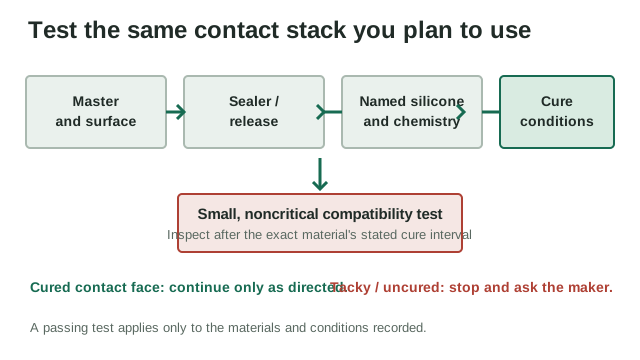
Test the entire combination before committing the master
Use the same master material, preparation, sealer, release agent, silicone, ratio, mixing method, thickness, and cure conditions planned for the mold. Choose a small noncritical area. Let the test reach the product’s stated cure period, then inspect the contact face for gummy or uncured material.
If the test fails, do not assume that adding a different layer of sealer, heating the master, or switching cure chemistries will fix it. Check the exact manufacturer procedure and ask for product-specific guidance. Keep all test materials and results identified.
Treat UV-resin prints as their own documented case
A printed model can look finished while some surfaces remain insufficiently post-cured. In the named manufacturer guidance for SLA masters, the procedure describes cleaning and post-curing the print, rotating it so all faces receive exposure, and checking the specific silicone/treatment combination. That guidance specifies a minimum UV exposure for its described case; do not transfer the duration or cleaning steps to another printer resin without its own instructions.
Deep recesses and shaded areas may receive different exposure than open faces. If the full model cannot be prepared and checked as instructed, use the makers’ guidance before pouring silicone over it. A successful test on a flat patch does not establish the condition of an unexposed cavity.
Worked example
A printed master produces tacky silicone only at a recessed detail
Assumptions
- The example concerns an SLA/UV-resin model and a named addition-cure silicone.
- The manufacturer’s relevant procedure requires a fully post-cured master and recommends a small compatibility test for uncertain combinations.
Inputs or observations
- Observed pattern: the silicone is firmer away from the master but gummy at a recessed detail.
- Contact stack: printed resin, cleaning/post-cure state, any sealer/release product, and named silicone.
- Unknown: whether UV reached the bottom and walls of the recess and whether every treatment was fully dry.
Calculation or decision path
- Record the model’s resin, orientation, cleaning, post-cure coverage, treatment products, and silicone lot.
- Compare each step with the exact print-resin and silicone maker instructions.
- Repeat only the manufacturer’s small compatibility test on a noncritical area with the same material stack.
Result: The observation is consistent with a contact-surface issue but does not prove a single cause. Do not infer that every SLA resin or sealer behaves alike; obtain product-specific advice if the test remains tacky.
Common questions
- Does a gummy interface prove sulfur contamination?
- No. It is an observation that requires checking the product, master, treatments, contact materials, mixing, and cure conditions.
- Can one sealer prevent inhibition with every silicone?
- No. Use only a product-specific procedure and test the complete contact stack.
Test a named material stack, not a material category
Cure-inhibition checks are useful when every material and surface treatment is identified. Keep the procedure specific to that combination, record the test, and do not treat a risk list as a guarantee that unlisted surfaces are compatible.
- Identify platinum versus tin cure and exact product variants.
- Test the same master, coatings, release agent, and contact materials.
- Follow the selected makers’ current instructions; this page supplies no universal sealer or UV schedule.